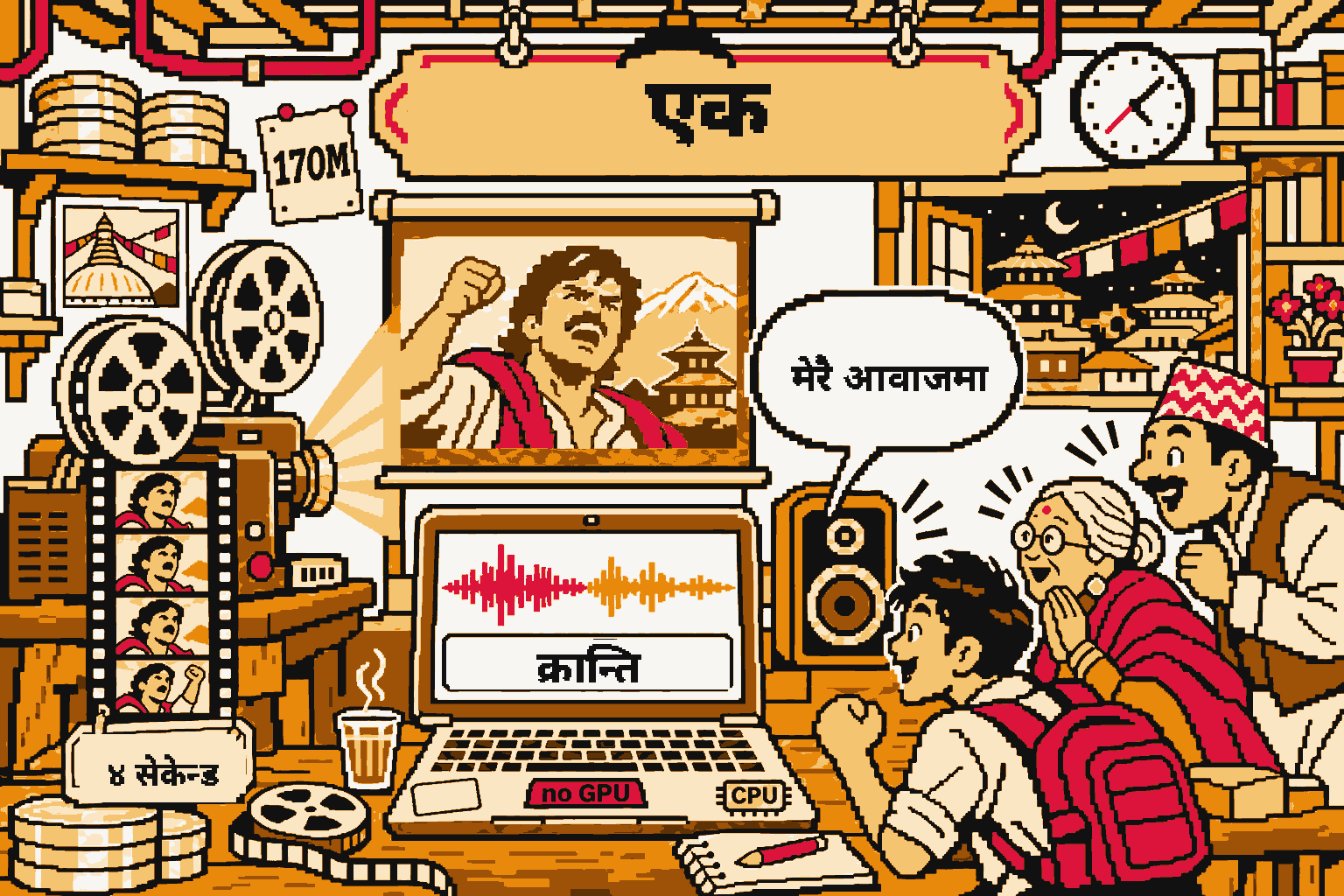
TL;DR. Eka is our Nepali fine-tune of Audio8-TTS-Preview-0.1b. You give it a few seconds of someone's voice and Nepali text, and it reads the text in that voice. The release checkpoint, eka-ft-v7, has a 170M-parameter generator, half the size of Swar's, and runs without a GPU at RTF 1.18 on an M3 Pro laptop. On our frozen Hindi Leak Scorer it is flagged on 18 of 103 readings, lower than every public model we ran, where Swar is flagged on 36 of 100. On NepTTS-Bench it has the highest UTMOS (4.07) and SCOREQ (4.50) naturalness scores of every model we tested. Its weak point is voice match: 0.52 on the Naamche cloning bench, against 0.70 for stock OmniVoice. All numbers here are automatic scores, and nobody has run a listening panel yet.
What Eka is
Audio8 is a small open text-to-speech model whose stock checkpoint barely speaks Nepali: on the Naamche Labs cloning bench, clean track, it gets 84.5% of characters wrong. We trained it nine times and kept every checkpoint. They ship under release names:
| Release | What it is |
|---|---|
| eka-ft-v1 | Supervised Nepali training, wave 1 (318.8 h) |
| eka-ft-v2 to v5 | Supervised waves 2 to 4 (575 h) |
| eka-ft-v6 | Preference training (DPO), round 1 |
| eka-ft-v7 | DPO round 2. This release. |
| eka-ft-v8, v9 | DPO round 3 steps. v9 has the fewest word errors and also runs on a CPU |
How it learned Nepali
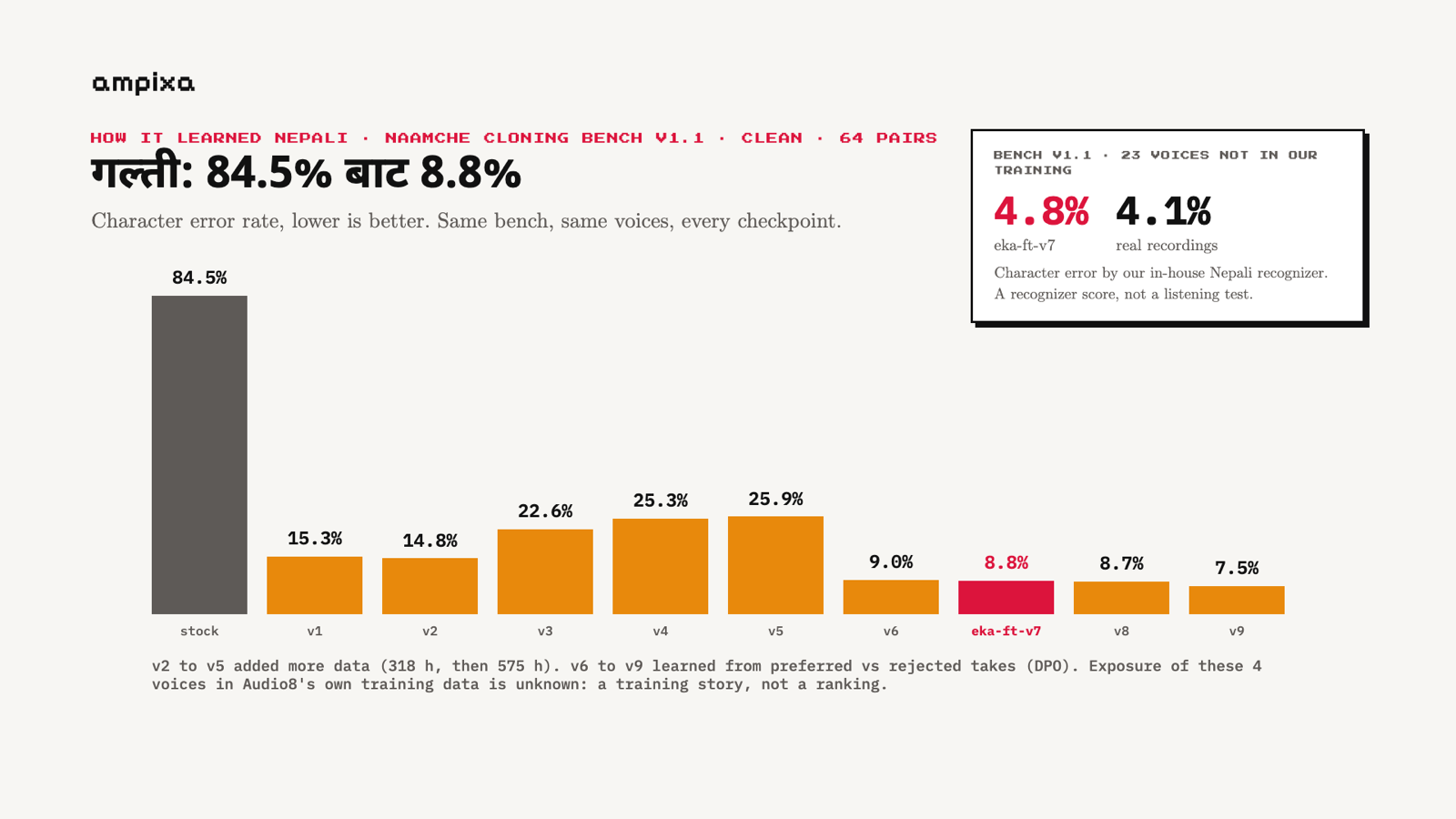
More data did not move the error rate. Preference training did. Going from 318.8 hours to 575 hours of supervised data left character error flat: 12.39% at eka-ft-v1 and 12.42% at eka-ft-v4 on bench v1.1, 23 voices not in our training. Then we stopped adding recordings. The model generated six takes of each prompt, a recognizer and a speaker judge scored them, and DPO pushed it toward the best take. After 784 updates and no new audio, eka-ft-v7 sits at 4.82% on the same voices; real recordings of those speakers score 4.14%. The paired change from eka-ft-v4 is −7.60 points (95% interval −11.64 to −4.36), and 20 of 23 speakers improved. A second recognizer outside the reward, MMS, agrees: 31.32% to 16.34%.
Small, and no GPU
| Model | Generator parameters | Status |
|---|---|---|
| Eka | 170M | this release |
| Chatur v2 | 249M | unreleased |
| Swar | 337M | public |
| OmniVoice | 613M | public |
| VoxCPM2 | 2.31B | public |
Codecs and vocoders are not counted; Eka adds a 130M decoder. The ONNX INT8 export runs on an Apple M3 Pro CPU with 4 threads at RTF 1.18 on a 39-second paragraph, median of three runs: a little slower than real time, with no GPU. We do not show a CPU speed comparison, because the other models' CPU numbers were measured on a different machine.
Natural-sounding for its size
NepTTS-Bench, 205 sentences:
| Model | Generator parameters | UTMOS ↑ | SCOREQ ↑ |
|---|---|---|---|
| Eka (eka-ft-v7) | 170M | 4.07 | 4.50 |
| Eka (eka-ft-v9) | 170M | 4.02 | 4.48 |
| OmniVoice | 613M | 4.02 | 4.17 |
| VoxCPM2 | 2.31B | 3.91 | 4.07 |
| Swar | 337M | 3.88 | 4.36 |
| Stock Audio8 | 170M | 3.67 | 4.22 |
UTMOS and SCOREQ are automatic naturalness predictors, not listeners. Against stock Audio8, the same 170M model before our training, character error on this bench fell from 92.0% to 13.8%. Swar still has fewer character errors here (6.3%).
Hindi leak
Most Nepali TTS starts from a Hindi-trained model, and some Hindi pronunciation can survive fine-tuning. Our Hindi Leak Scorer checks key words for a vowel that moved the Hindi way. We ran the same frozen scorer (v84, model 58422b5a) on the same 26 sentences in the same 4 voices for every system:
| System | Status | Readings flagged |
|---|---|---|
| IndicF5 | public | 60 / 93 |
| VoxCPM2 | public | 55 / 91 |
| Swar | public | 36 / 100 |
| OmniVoice | public | 34 / 104 |
| Eka (eka-ft-v7) | this release | 18 / 103 |
| Eka (eka-ft-v9) | public | 15 / 103 |
| Ampixa Pocket teacher | unreleased | 4 / 104 |
The denominator is the readings that passed the scorer's word check. A flag is a candidate for a listener, not a confirmed error, and the scorer has no blind-listener calibration yet. OmniVoice ran with our inference settings on its stock weights.
Against public models
| System | Status | Character error | Voice match | UTMOS |
|---|---|---|---|---|
| Eka v7 | this release | 8.8% | 0.52 | 3.24 |
| Eka v9 | public | 7.5% | 0.48 | 3.33 |
| Swar | public | 5.6% | 0.69 | 2.67 |
| OmniVoice | public | 5.0% | 0.70 | 2.63 |
| VoxCPM2 | public | 9.0% | 0.68 | 2.40 |
| Chatur v5 | unreleased | 5.4% | 0.67 | 2.79 |
| Audio8 base | public | 84.5% | 0.34 | 2.73 |
Naamche cloning bench v1.1, clean track, 64 prompt and sentence pairs; our harness reproduces Swar's published numbers on it. Training exposure of these voices is unknown for every row, so this is not a ranking. UTMOS is an English-trained naturalness predictor, not a listening test.
What Eka is not
- Not the best voice cloner here. Its voice match, 0.52, is the lowest in the table. In the release film, Eka cloning a four-second film line reaches 0.38 to 0.43 by the same judge, where the actor's own other lines score 0.71 to 0.79.
- Not the most accurate. OmniVoice, Swar and Chatur all have fewer character errors on the cloning bench.
- Not fast on a GPU. On an L40 it was the slowest family in bench v0, RTF 1.065. It is also not smooth when streaming on a CPU. The test script has an experimental
--playmode that speaks while it generates; on the M3 Pro the first audio comes after about 5 seconds, and a 13.9-second paragraph paused six times and took 34.6 seconds, against 16.3 seconds without streaming. - Not ready for older Intel CPUs. On an Intel i5-10400 (AVX2, no VNNI), the INT8 export broke on 11 of the first 12 test sentences: some stopped at once, others ran to the length cap. The same files, text and seed were fine on the Mac. Windows and Linux builds wait for that fix.
कसरी try गर्ने
Everything is public in one Hugging Face repo, ampixa/audio8-nepali: all nine fine-tunes under their release names, CPU builds of eka-ft-v7 and eka-ft-v9, and a test script. No sign-up needed:
pip install "onnxruntime==1.23.2" "numpy<2.5" soundfile scipy tokenizers huggingface_hub
hf download ampixa/audio8-nepali --include "onnx/*" --include "onnx-v9/*" --include "runtime/*" --include "voices/*" --include "examples/*" --local-dir eka
cd eka
python examples/speak.py --model v9 --text "नमस्ते, म एक हुँ।" --out hello.wav
python examples/speak.py --model v9 --ref me.wav --ref-text "exactly what me.wav says" --text "नमस्ते, म एक हुँ।" --out me.wav
python examples/speak.py --text "नमस्ते, म एक हुँ।" --play    # experimental streaming, needs pip install sounddevice
Use --model v9 when the words matter most: it makes fewer word and pronunciation errors. Use --model v7 when sounding like the reference speaker matters most. The second line clones your own voice from 4 to 10 seconds of speech. Astadhwani is a desktop app for Eka, today a Mac arm64 preview; Windows and Linux are आउँदैछ.
Licence and limits
The Audio8 Community License bars commercial use at or above US$2M annual revenue and needs consent before cloning someone's voice. Clone only voices you have permission to use. Upstream training exposure of the bench speakers is unknown. The 318.8 hours is a README figure we did not re-derive. All numbers are automatic scores: recognizers, a speaker judge, a naturalness predictor and a pronunciation scorer, none of them a human panel.