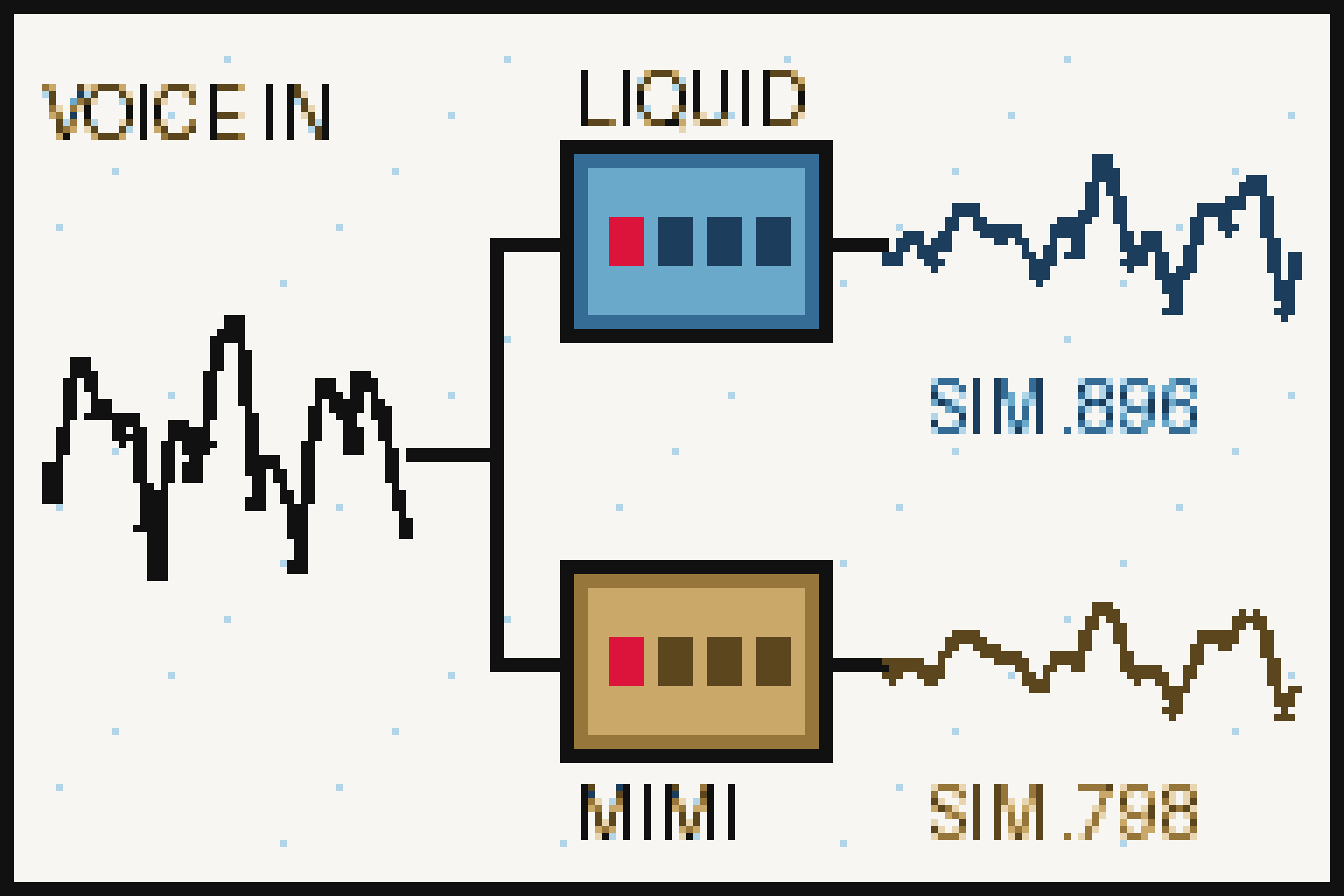
TL;DR. After one encode-decode round trip, LiquidCodec keeps a speaker's voice clearly better than the Mimi-based codec in Kyutai's Pocket TTS: speaker similarity 0.896 vs 0.798 on 200 English clips and 0.845 vs 0.721 on 270 Nepali clips. Word and character errors are equal or lower. It scores lower on the UTMOS naturalness predictor, partly because the Pocket codec scores above the original recordings.
We put real English and Nepali speech through two speech codecs and back, and measured what came out. The codecs are LiquidCodec (Liquid AI, revision b5abfac4) and the Mimi-based codec inside Kyutai's Pocket TTS, which our current TTS models use. LiquidCodec keeps the speaker's voice clearly better in both languages and is at least as intelligible. It scores lower on automatic naturalness predictors. The Pocket codec scores above the original recordings on those predictors, which means it is changing the audio, not only reproducing it.
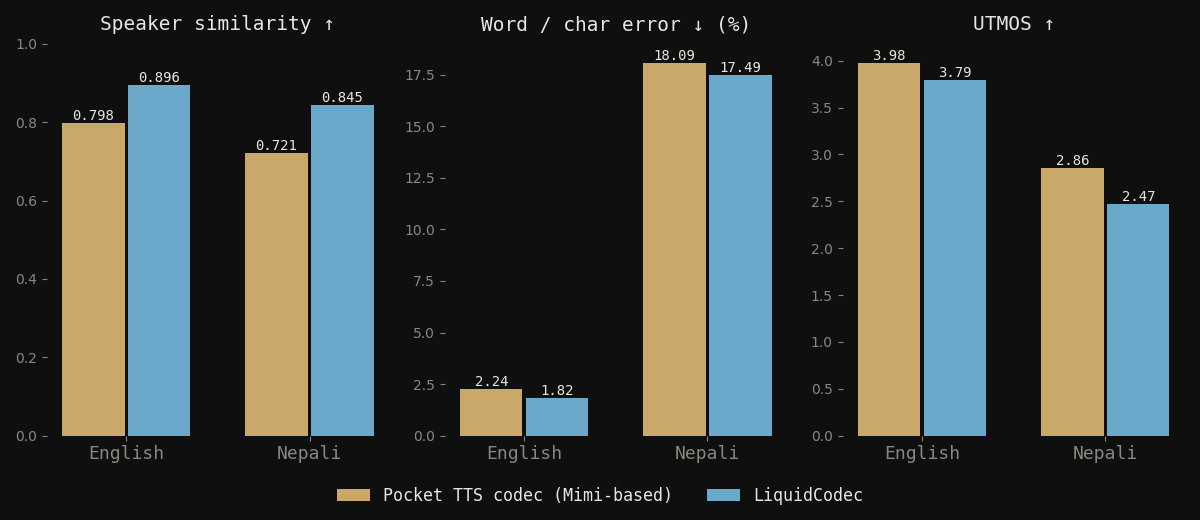
LiquidCodec (blue) wins on voice match in both languages and loses on UTMOS. Error rates are close.
The two codecs
| LiquidCodec | Pocket TTS codec (Mimi-based) | |
|---|---|---|
| Sample rate, frame rate | 24 kHz, 12.5 Hz | 24 kHz, 12.5 Hz |
| What a TTS model predicts per frame | 12 tokens, from grouped finite scalar quantization (48 values) | 32 continuous values |
| Parameters | 73.6M total, 36.4M on the decoder side | 20.1M total, 10.3M on the decoder side |
| Licence | LFM Open License v1.0 (commercial use only below US$10M annual revenue) | as published by Kyutai with Pocket TTS |
This is the codec Pocket TTS uses, not the original 79M discrete Mimi codec that Liquid AI compares against on its model card.
Method
Each clip is encoded and decoded once with each codec, with no TTS model involved. The original recording is scored alongside the reconstructions, so the original is the reference point for every metric.
- English: 200 clips from the validation split of HiFiTTS-2, covering all 28 validation speakers.
- Nepali: 270 full-band 24 kHz clips. 120 are studio recordings from the test split of the Rasa corpus. 150 are conversational clips from Nepali live streams, taken from 6 videos that none of our models trained on.
- Word errors:
- English uses Whisper-large-v3 WER.
- Nepali uses CER from our in-house Nepali speech recognizer, plus MMS-1b-all CER as a second check.
- Speaker similarity: cosine similarity between WavLM-ECAPA speaker embeddings of the reconstruction and the original.
- Spectral distance (mel L1): mean absolute difference in log-mel spectrum against the original.
- Naturalness: UTMOS, and for English also SCOREQ. Both are automatic predictors trained to imitate listener ratings, not listening tests.
- Intervals: the bracketed figures are 95% paired bootstrap confidence intervals over clips for LiquidCodec minus Pocket.
English (200 HiFiTTS-2 clips)
| WER | UTMOS | SCOREQ | Speaker similarity | Mel L1 | |
|---|---|---|---|---|---|
| Original | 1.01% | 3.81 | 4.14 | 1.000 | 0 |
| Pocket codec | 2.24% | 3.98 | 4.17 | 0.798 | 1.247 |
| LiquidCodec | 1.82% | 3.79 | 4.11 | 0.896 | 0.777 |
| LiquidCodec − Pocket | −0.42 pp [−1.17, +0.32] | −0.19 [−0.23, −0.16] | −0.06 [−0.09, −0.04] | +0.098 [+0.090, +0.106] | −0.47 [−0.48, −0.46] |
The WER difference is not significant. The speaker-similarity and spectral differences are large and consistent across clips.
Nepali (270 clips)
| CER, in-house | CER, MMS | UTMOS | Speaker similarity | Mel L1 | |
|---|---|---|---|---|---|
| Original | 15.95% | 19.35% | 2.63 | 1.000 | 0 |
| Pocket codec | 18.09% | 26.74% | 2.86 | 0.721 | 1.278 |
| LiquidCodec | 17.49% | 24.56% | 2.47 | 0.845 | 0.878 |
| LiquidCodec − Pocket | −0.60 pp [−1.20, 0.00] | −2.19 pp [−3.32, −1.13] | −0.39 [−0.42, −0.35] | +0.124 [+0.116, +0.132] | −0.40 [−0.41, −0.39] |
Split by source:
| CER, in-house (original / Pocket / Liquid) | Speaker similarity (Pocket / Liquid) | UTMOS (original / Pocket / Liquid) | |
|---|---|---|---|
| Studio, Rasa (120) | 10.92 / 12.25 / 11.30 | 0.728 / 0.883 | 3.43 / 3.36 / 3.09 |
| Live streams (150) | 19.37 / 22.07 / 21.70 | 0.715 / 0.814 | 1.99 / 2.46 / 1.98 |
On the noisy stream clips the Pocket codec raises UTMOS from 1.99 to 2.46, well above the original. LiquidCodec stays at the original's level.
What this means
- For voice cloning, LiquidCodec is the better codec. It keeps about 0.10 more speaker similarity in English and 0.12 more in Nepali. Its reconstructions are also much closer to the original spectrum. A TTS model can reproduce a voice only as well as its codec does.
- Intelligibility is no worse. Word and character errors after LiquidCodec are equal to or lower than after the Pocket codec in both languages.
- Naturalness scores need care. The Pocket codec scores higher than the original recordings, so a higher naturalness score here does not mean a more faithful codec. If a TTS project is judged on UTMOS alone, the Pocket codec will look better.
- Size and speed. LiquidCodec's decoder is 3.5 times larger. On one CPU thread of our L40 server (FP32, shared machine), it decoded whole utterances at a real-time factor of 0.045 (22 times faster than real time). Streaming one frame per call was much slower, at 0.69. Four frames per call brought it to 0.089.
What this comparison is not
- These are reconstruction tests. They show what each codec can preserve, not how a TTS model trained on it will sound. We are training two otherwise identical TTS models, one per codec, to measure that directly.
- Every quality number is automatic. No listening panel was run.
- HiFiTTS-2 is audiobook speech, and 200 clips is a moderate sample. The Nepali set has 270 clips from two sources.