Two results. No shared file.
The 30.1% top-5 number is real and audited — but it's about guessing a word from a dictionary of 3,653 signs, not about reading the manual alphabet, which has no working recognizer at all.
A static research-progress report, not an interactive demo — nothing to click runs a model. Its own footer says so and dates it 14 July 2026, before the fingerspelling dataset existed.
Naming note. The page's own stats table names the teaching-channel instructor by first name in one row — against the project's stated policy of not naming him publicly until he agrees. We don't repeat that name here.
A deaf signer in Nepal signs a word for a camera. Software has to guess which of 3,653 known concepts it was. On 219 held-out clips it never trained on, the right answer is in the top five guesses 30% of the time — a real, audited number. The same project separately built something else entirely: pose data for Nepali's manual alphabet, 36 consonants and 13 vowels, now public under an open licence. Nobody has built a reader for it. These are not two views of one system. They are two pieces of work filed under one name.
NSL research program
Which of 3,653 words did you sign?
3,653 reference signs, crawled from the National Deaf Federation Nepal's online dictionary. A clip from a public teaching channel, never trained on. Both turned into pose sequences with an existing model built for sign language in general, then searched against each other.
A separate check against real parliament broadcast footage — 787 candidate segments, same 3,653-sign gallery, spoken captions as a rough guess — agreed only ~2% of the time. Three later attempts to train around the continuous-signing gap all failed their own pre-declared validity checks; none get a reported score.
Both the gallery and the 219-/37-clip eval sets are built from rights-reserved or no-agreement video. Neither is publishable alongside this number.
What does each letter's handshape look like?
NSL23: 630 videos, 1,205 gestures of Nepali's 36 consonants and 13 vowels, signers coded S1–S14, already public under an open licence — the one piece of this whole project built entirely from video that didn't need anyone's further permission to reuse.
ampixa/nsl-fingerspelling-poses · CC BY 4.0 · public since 2026-09-102-D COCO-WholeBody pose sequences, 133 keypoints a frame, extracted with RTMPose on CPU — zero pose failures across all 630 source videos. Reference banks of what each letter's handshape looks like across different signers, including a 3-D, viewpoint-independent variant.
An attempt to find where one fingerspelled letter ends and the next begins lost to a coin-flip baseline. A prior count of usable letter-to-letter transitions (218) is withdrawn because the boundaries it depended on fail that test. No fingerspelling recognition model has been trained, on this dataset or any other, as of September 2026. A pose bank is not a reader.
Explicitly excluded from this release, by written policy: anything from the NDFN dictionary, the parliament broadcast, or a consented recording session promised it would not be publicly distributed.
What's missing, on both sides
// the one place these two branches are discussed together — because both are incomplete
- Three of six underlying data tiers — the NDFN dictionary, the parliament broadcast, the interpreter session — stay gated behind agreements that, per the project's own provenance notes, do not yet exist in writing.
- The interpreter-session consent form on file is an unfilled template; a signed copy is said to be held offline by the research lead, but which specific permissions it grants isn't recorded anywhere this page's sources could read.
- Continuous (sentence-level) signing collapses from 30.1% to 5.4% top-5 versus isolated signs, and three later attempts to close that gap all failed pre-declared checks.
- The live research page predates the fingerspelling dataset entirely and, separately, names the teaching-channel instructor against the project's own stated policy — see the naming note above.
- The current ampixa.com homepage says the project's "pose data... are not [public], pending agreements" — true for the gated tiers, but it overstates the gap: the fingerspelling pose dataset has been public since 2026-09-10.
- What would actually move this forward isn't a bigger model. It's one or two paid, experienced NSL signers willing to confirm where a sign starts and ends in clips that already exist.
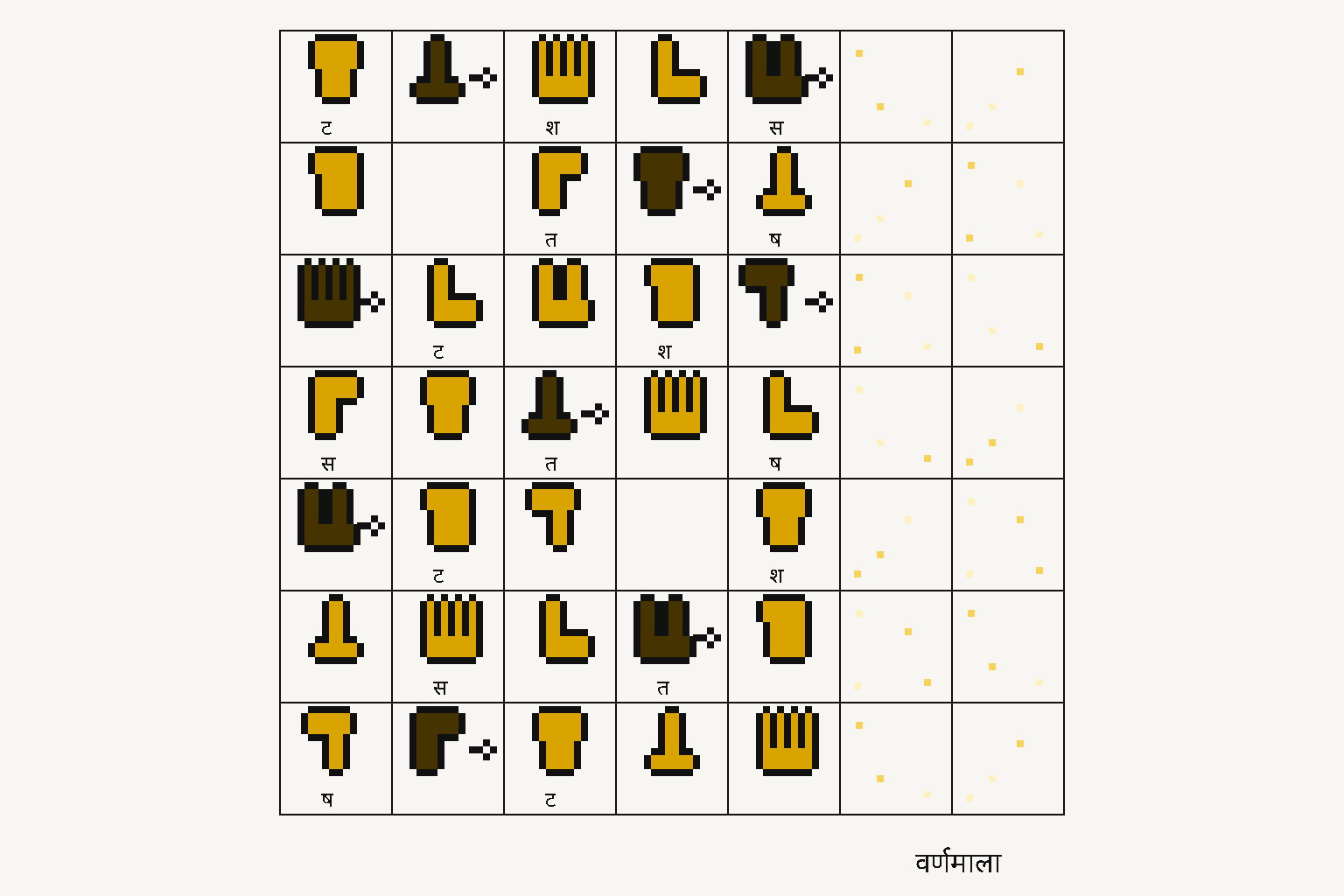
No body, no face — just the wrist and finger joints a pose file actually stores. The glyphs are this project's own terms; the shape is a dedicated stencil, not a crop of the key art, built to read as a hand at Field size rather than as a wall of text.