The best version of this model has one copy, on one machine
Say you want a phone, with no signal, to read a sentence out loud in Nepali. We forked Kyutai's Pocket TTS — a small, CPU-friendly speech model that had never heard a word of Nepali — compared it zero-shot against our own trained Nepali voice-cloning system, and it won. What we built on top of that win is a teacher, a student, and a storage problem we only partly fixed.
// demo
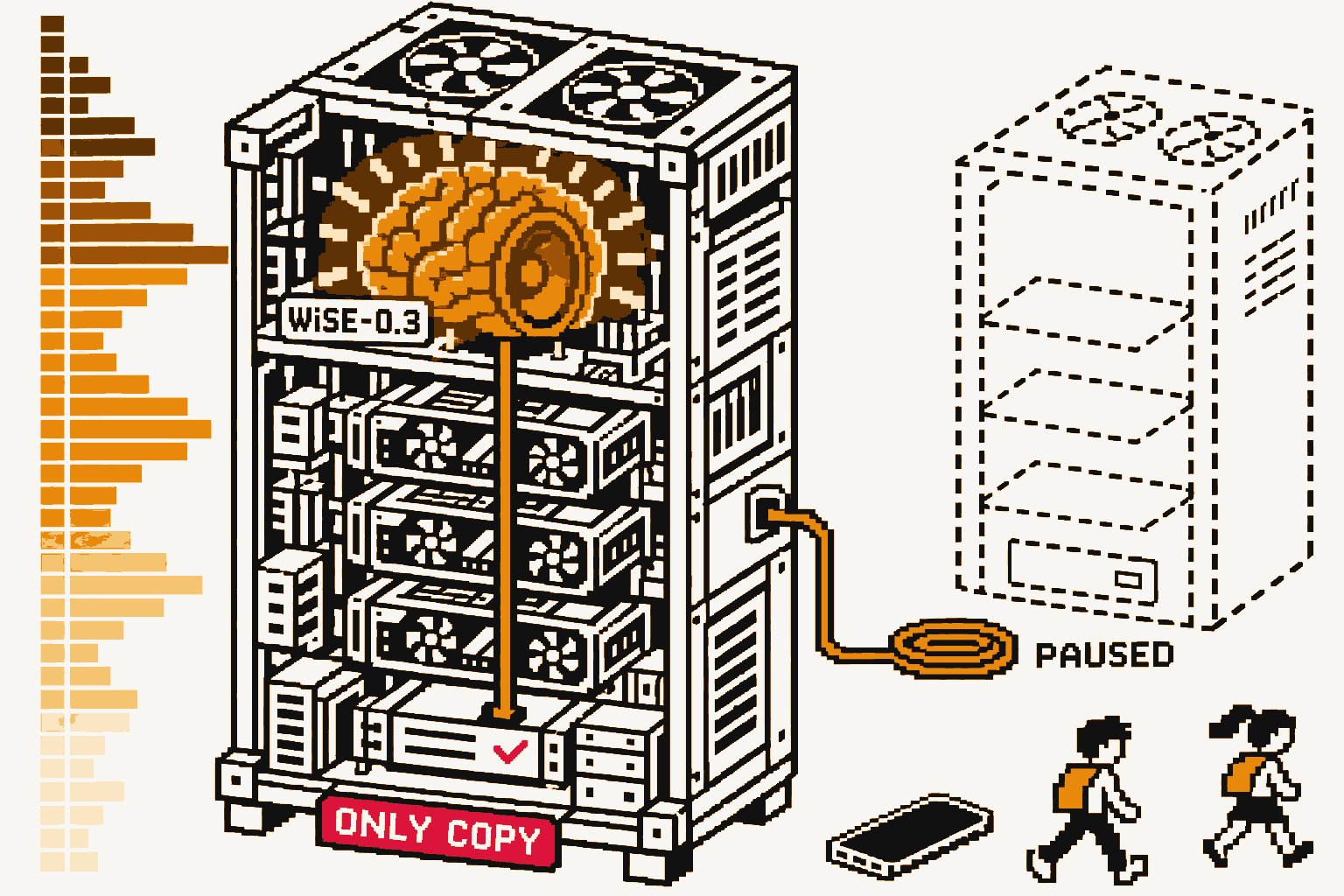
Our best Nepali voice model exists as one copy, on one machine.
not public yet"Best" = lowest Nepali CER we've recorded (10.6%, one internal pass, not independently re-run). Hash-verified on disk; no off-box backup yet.
0.487→ECAPA truth cosine · Pocket (Hindi checkpoint, zero-shot) vs Audio8's 0.400 · 24-speaker probe
14.2%→CER · same zero-shot Pocket run vs Audio8's 23.8%
0.099×→CPU real-time factor, 4-thread · vs Audio8's 0.665×
34.7%→Seed-TTS CER · the distilled student on Nepali, vs its own teacher's 16.2% on the same set
// the take log · a verdict stamped per take, not averaged into one score
take 1audio8the trained performer
Audio8 is our existing Nepali voice-cloning system — a 169.8M-parameter generator plus a 130M codec decoder, built the slow way on roughly 92 hours of audio across 1,300 speakers. On a 24-speaker development probe it scored an ECAPA truth-similarity cosine of 0.400 and a 23.8% character error rate, running at 0.665× real time on a four-thread Apple M3.
KEEPbuilt the hard way, months of work
take 2pocket, hindi checkpointzero-shot, never trained on nepali
Same 24 voices, same texts, same scorers: Pocket's Hindi checkpoint, which has never heard a word of Nepali, against Audio8. It won — 0.487 ECAPA truth similarity against 0.400, 14.2% character error rate against 23.8%, and six times faster, 0.099× real time against 0.665×. It took 18 of 24 voices on similarity and 19 of 24 on accuracy, with the kind of statistics (paired Wilcoxon p=.0096 and p=1.3×10⁻⁴) that make you re-check your spreadsheet. The win has a catch built into it: Hindi training leaks into Nepali as mispronunciation — Hindi-shaped sounds for Nepali-shaped words. And this is a 24-speaker development probe, not a product benchmark; it supports "pick Pocket as the base," not "Pocket beats Audio8."
KEEPcloser-sounding, more words right, six times fasterNO GOODit's speaking Hindi-shaped Nepali, not Nepali
take 3soup → wise-0.3the best teacher we've made
We trained a from-scratch bilingual Nepali/English teacher, averaged two training snapshots together — "souping" — into a 340M-parameter model: 12.3% Nepali CER, 3.5% English Seed-TTS WER. (A separate, independent harness later scored the same checkpoint under harder conditions and got far worse, inconsistent numbers, up to 95.8% CER on one test set — its own notes call that a "failed/limited" run, not a deployment pass.) We then blended the soup 30/70 with another checkpoint by hand and called it WiSE-0.3: Nepali CER down to 10.6% — from one internal pass, not independently re-run, the same evidentiary footing as the soup number above — English essentially unchanged. As far as our own notes show, it's the best teacher we've made — the tower at the top of this page is that checkpoint.
For a while that model lived only in a GPU machine's RAM — if the machine had rebooted before anyone checked the backups, it would have simply stopped existing. We've since fixed the urgent part: it's copied to disk now, and we checked the copy against the original byte for byte. We started a second, off-box copy on a separate machine too, then paused partway through.
ONLY COPYoff-box backup: paused
KEEPbest sound on file, now on disk, hash-verified
take 4the distilled student18m params, fast enough to ship
The point of a teacher is to make a student small enough to actually ship. We distilled one down to 18M parameters. In English it's fine: first audio in about 41ms, 0.20× real time on one CPU thread, 2.1% Seed-TTS word error rate — matching a separate English-only student built the same way, which also has no Nepali capability at all. In Nepali it fails: 34.7% Seed-TTS CER, more than double the teacher's 16.2% on that same Seed-TTS set (a different scoring protocol than the 10.6%/12.3% "user-suite CER" figures above — the source table doesn't say whether this is the soup teacher or WiSE-0.3 scoring 16.2%, just "teacher"). The source's own words for this result: "fails NE."
KEEPenglish — 41ms to first audioNO GOODnepali — the language this line exists for
// who's actually in this training data — no voice names, on principle
The teacher/student line on the Madhyam branch trains on YouTube audio under an Ampixa–channel agreement that covers research, not necessarily redistribution. The underlying speakers are private, unknown identities; consent and leakage review are explicitly unresolved in our own project notes.
An earlier expressive teacher trains on an internal streamer's voice, recorded for development, with no consent for release. Its matching student was never trained.
The soup teacher and WiSE-0.3 both train in part on non-commercially-licensed sets plus the same YouTube agreement data; marked internal-only.
Both compact students derive from Kyutai's public Pocket base weights, which carry a CC-BY-4.0 grant with a no-unconsented-voice-cloning clause — a restriction the upstream license itself exists because of.
A related adapter in the same lineage uses a third-party voice. Our own source annotates it, in full: "never publish."
// field · this project's own words, shining through the tower above
The glyphs are Pocket TTS's own vocabulary, Devanagari and Latin, tiled once. The picture underneath is a drawn stencil, not a photograph or a spectrogram — the same storage tower from the key art above, reduced to flat shapes and one lit drive bay so it still reads as a shape once it's made of text.
// still open
WiSE-0.3's one copy sits on one machine. The off-box backup exists only as a paused job, not a second copy.
The bilingual compact student fails Nepali (34.7% vs the teacher's 16.2%); only the English-only student is release-quality, and it has no Nepali capability at all.
No human listening test, no in-domain/out-of-domain qualification, and no passed eval-gate review for any teacher, soup, WiSE, or student checkpoint named here. The 2026-11-04 TTS eval gate recorded 15 candidates: 6 FAIL, 9 INCOMPLETE, 0 accepted.
Speaker consent, data licensing, and leakage review for the YouTube-agreement and internal-streamer training data remain explicitly unresolved in our own notes.
The demo is not public.
// related projects, speak lane
sanoTTS
Audio8
RVC
codecs
// receipts · every number on this page is in facts.md
Soup teacher: 340M params, soup of phase-1/phase-3 EMA checkpoints; Seed-TTS EN WER 3.5%, Nepali user-suite CER 12.3% — not independently re-run, see next line; sha256 prefix 12b6dcf71188 — facts.md (internal source capture, 2026-11-05 research sweep, doc[627]; doc[501] row 3)
Second, independent measurement of the soup checkpoint (2026-10-30 head-to-head harness): CER up to 95.84% (FLEURS set), "failed/limited results," not a deployment pass — facts.md (internal source capture, 2026-11-05 research sweep, doc[262])
WiSE-0.3 (0.3 × soupfix_v2 step-4500 EMA + 0.7 × soup teacher): Nepali CER 10.6% vs soup's 12.3% — one internal pass, not independently re-run, same footing as the soup number above; EN WER n.s.; sha256 prefix af2608252cf2 — facts.md (doc[627] row "Best bilingual teacher"; doc[501] row 4, §2 item 8)
WiSE-0.3 durability update: copied from /dev/shm to persistent disk on one GPU machine, hash-verified; off-box backup started and paused by the user, does not yet exist — lead, session ampixa-7d, 2026-11-05 (facts.md "Update — teacher checkpoint durability")
Bilingual compact student (18M base + Nepali tokens, stage C): ~41ms first audio, RTF 0.20 (1 thread), EN Seed WER 2.1%, Nepali Seed-TTS CER 34.7% vs teacher's 16.2% on the same Seed-TTS set — a different protocol than the user-suite CER figures above; source doesn't specify which teacher checkpoint ("fails NE") — facts.md (doc[627] row "Bilingual compact student")
English-only compact student: same 18M base, EN Seed WER 2.1%, speaker-similarity 0.406, no Nepali claim — facts.md (doc[627], next row)