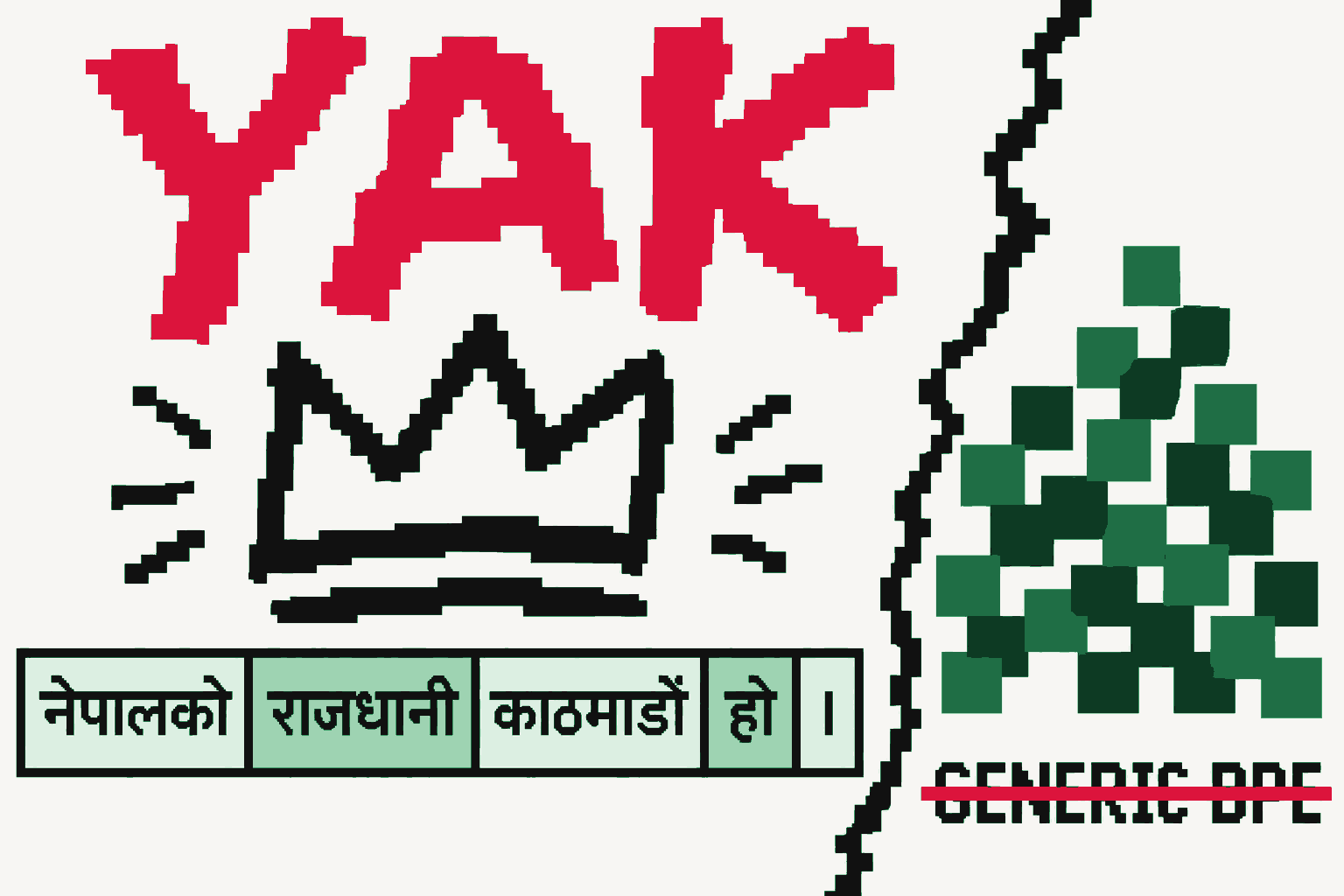
Type that sentence in Nepali — नेपालको राजधानी काठमाडौं हो । — into most language models and watch what happens underneath. The model doesn't see words. It sees tokens, chunks that a tokenizer decided to cut the sentence into, and for a long time the tokenizers everyone used were built by people thinking in English. Devanagari script, with its vowel signs and conjunct consonants and virama marks, wasn't the shape they had in mind. So a Nepali sentence that a person reads as four words gets chopped into far more pieces than an equivalent English sentence. More pieces means more compute, slower generation, a smaller window to think in, and a higher bill — for the same sentence, just because of which script it's written in.
That's the problem Yak is aimed at. It's a byte-level tokenizer, built from scratch, with a pretokenizer that was taught to respect Nepali word boundaries instead of splitting blindly on vowel signs and joiners. Ampixa released seven versions of it on Hugging Face — small and large vocabularies, a plain v1.0, a wider v2.0 that adds text from other languages spoken in Nepal, and two experimental "phrase" variants that let a single token span up to four words.
The numbers are real, but they don't all belong to the same tokenizer, and it's worth being precise about that — precise enough that the correction sits in the headline above, not buried in a footnote. The record for fewest tokens per word of 42 lossless tokenizers tested, 1.267 on Nepali, belongs to the experimental v1.0 128k-phrase build, where one token can span several words. The best plain build on Nepali is v1.0 128k at 1.370, and it also edges out v2.0 128k on English and Hindi. v2.0 128k scores 1.382 on Nepali, still about 2.7 times fewer tokens than Llama-3 needs for the same text, and it is the one built for the wider country: averaged across fourteen other languages spoken in Nepal it needs 1.629 tokens per word against v1.0's 2.505, and it is the lowest-fertility lossless tokenizer on 18 of 19 languages tested.
There is no single winner. There is a record, a best Nepali build, and a best build for Nepal's other languages.
What's next is the obvious thing: train a model on Yak and measure whether fewer tokens per word really means a better or cheaper Nepali model. The tokenizer is done. Whether it was worth building depends on what gets trained on top of it.