
ampixa
// scripts & text · barnamala

वर्णमाला

15.6× smaller — and the test can't tell them apart.

99.735% vs 99.710%accuracy, distilled 1.11M student vs MallaNet 17.32M — 36.6 vs 40 errors of 13,800
p = 0.345McNemar's test, distilled student vs MallaNet — no significant difference detected
15.6×fewer parameters — 1.11M vs 17.32M
p = 0.701supervised control (no distillation) vs MallaNet — also no significant difference
// exhibit A

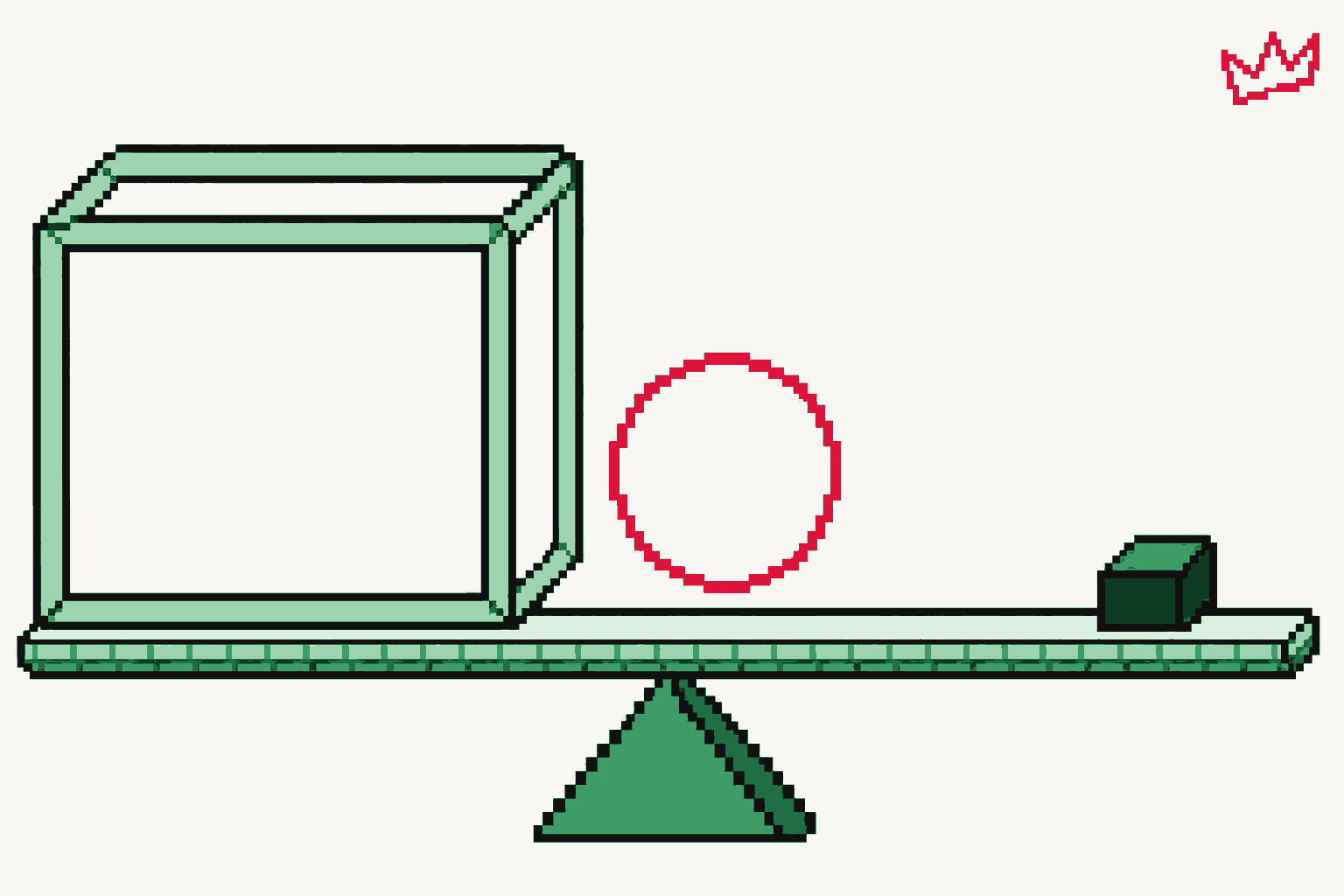
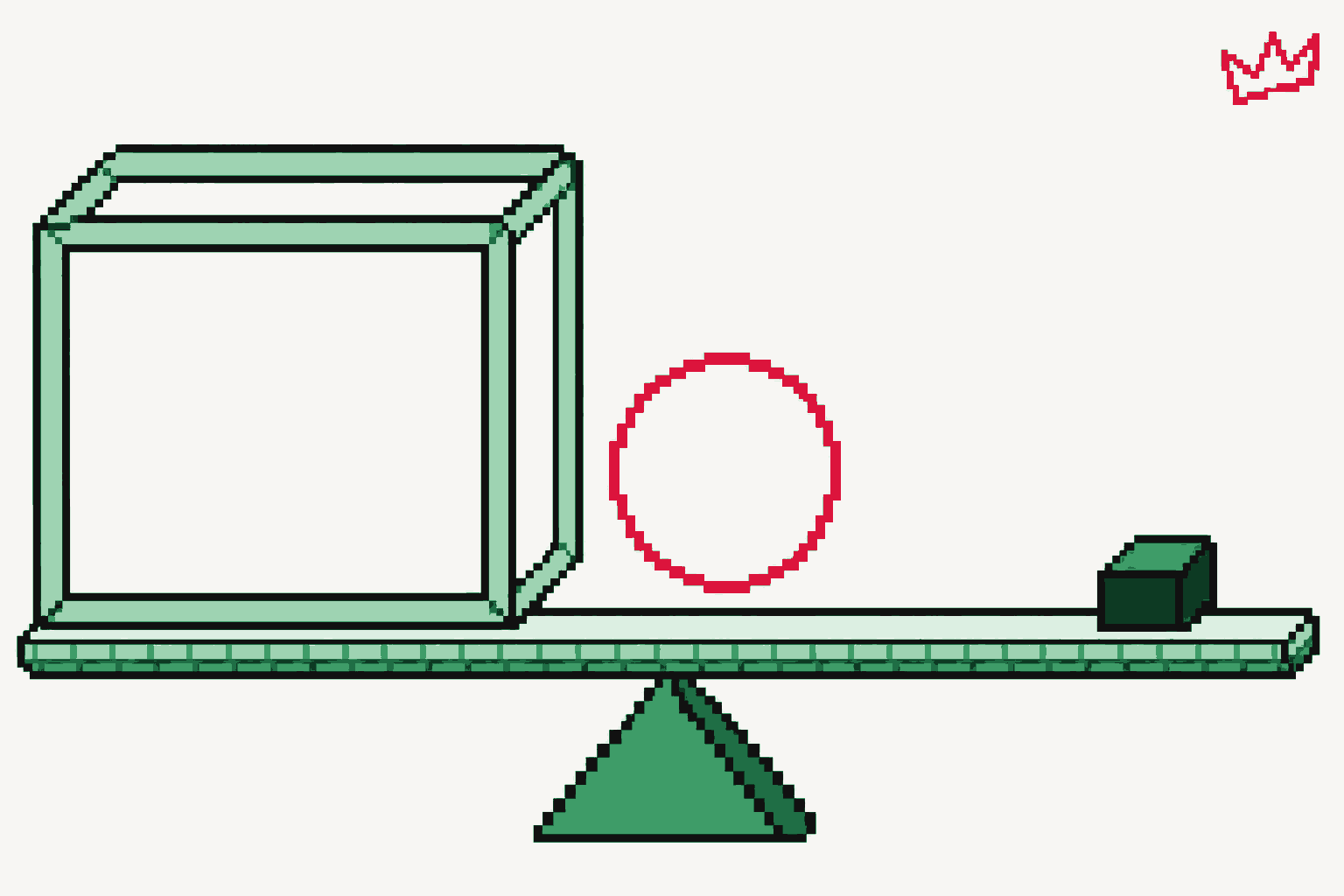
A level beam. Neither side gets to look like it won.

A pixel-art balance beam: a huge hollow outline of a box, big enough to fill half the frame, level against a small solid dense block a tenth the size. A blank stamp disc hangs above the fulcrum. Verdict: not proven. The stamp reads PROVEN struck through, with NOT PROVEN written beneath it in hand script — the test found no significant difference between the two models, which is not the same as proving they're equal.

Left: MallaNet, 17.32M parameters, drawn hollow — big, but empty inside. Right: the Barnamala student, 1.11M parameters, drawn small and solid. The beam never tips. "Proven" is struck out on purpose: McNemar's test can fail to find a difference, but that is not the same claim as proving there isn't one.

│ 11 of 13,800 — missed by all 15 student runs and MallaNet, every configuration, no exceptions

modelparamserrors / 13,800accuracyp vs MallaNet
MallaNet (reproduced baseline)17.32M4099.710%—
Barnamala, distilled (mean of 5 seeds)1.11M36.699.735%0.345
Barnamala, supervised control1.11M39.899.712%0.701

Say you want to read handwritten Devanagari on a phone, offline, in a village with no signal. You can't run a 17-million-parameter network on that phone. You need something small enough to fit, and you need to know it still works. That's the question Barnamala tests: not whether a bigger model can be built, but how small one can go before the numbers stop holding up.

The benchmark is DHCD — 46 handwritten Devanagari characters, a test set of 13,800 images. The model to beat is MallaNet, a published 17.32-million-parameter network. Barnamala's answer is a 1.11-million-parameter student, trained by having a committee of bigger "teacher" models vote on the training examples, then compressing what they agreed on into one small network. On the test set: MallaNet gets 40 of 13,800 wrong. The small model gets 36.6 wrong on average, across five separate training runs. Fewer errors, 15.6 times fewer parameters.

Fewer errors on one test set doesn't prove the small model is actually better — both numbers sit close to a floor every model in the study hits, and the gap could just be noise. So the team ran the test built for exactly that question: McNemar's test, which pairs the specific images each model got right or wrong against each other. The result: p = 0.345. In plain terms, the test cannot say the small model beats the big one — and it cannot say it's worse, either. No significant difference was detected. That's a real result, and a narrower claim than it sounds like: an absence of evidence against equality is not proof of equality.

What's underneath that number is more interesting than the headline. Eleven of the 13,800 test images are missed by every student run the project trained — all fifteen of them, across three different setups — and by MallaNet too. That's a shared wall. Whatever is wrong with those eleven images — bad handwriting, a mislabel, genuine ambiguity — no amount of extra training fixes it on this benchmark. The team calls it a label-noise floor. Nobody has sat down and adjudicated each of those eleven cases by hand, so it's a working theory, not a settled fact.

So what actually happened: a model 15.6 times smaller than MallaNet is not detectably different from it, on a saturated benchmark, using a training recipe that turns out not to depend much on the distillation step that inspired it. The supervised student — no teachers, no distillation, just ordinary training — is also not detectably different from MallaNet on its own, p = 0.701. That's a smaller, stranger result than "distillation works," and it's the one the data actually supports.

// what didn't move the needle

Four things the team tried that didn't help

  1. Growing the teacher committee from 9 to 15 models (no augmentation) changed nothing: both sizes plateau at exactly 30 errors (99.783%), p = 0.0755 — not significant.
  2. Training the student on "clean", non-augmented teacher targets instead of flip-augmented ones didn't help either: 38.2 errors vs 36.6 — not shown to be a real improvement.
  3. Horizontal-flip test-time augmentation — a common trick — actively hurt: distilled errors rose 36.6 → 36.8, supervised rose 39.8 → 40.2, and it pushed individual teacher models as high as 88 and 102 errors, up from a typical ~30 without it.
  4. The one row in the whole results table that does look statistically significant — a 9-teacher ensemble with the flip trick, p = 0.029 — depends entirely on that same harmful augmentation and a one-to-two-image margin. The project's own results summary says plainly it is not a defensible claim.
// where the floor is

The errors concentrate on a handful of close pairs

The project's own error analysis names four confusable pairs, drawn from DHCD's standard class labels. These sit inside the shared 13,800-image test set everything above is measured on.

धघ
dha / gha
बव
ba / waw
दढ
da / dhaa
त्रब
tra / ba

What's still open

for "proven equivalent" read
no significant difference detected in one paired McNemar test — which can fail to find a difference, but cannot prove two models perform identically. No formal equivalence or non-inferiority test has been run.
for "label noise" read
the project's own working theory for why 11 images are missed by every student run and MallaNet. Nobody has manually adjudicated those 11 cases by hand.
for "try the demo" read
there isn't one. No Hugging Face model page or Space (both checked today, both return 401), no hosted inference endpoint. The GitHub repo ships every prediction dump and checkpoint behind the numbers on this page, so anyone can recompute them without a GPU — that's the only way to check this today.
for "open source" read
the code is public, but no LICENSE file exists in the repo (404, checked today) — don't assume usage terms.
for "read the writeup" read
a blog post exists only as an unpublished draft (status: draft, never published). The URL that would carry its title on ampixa.com returns the site's homepage, not an article.
for "barnamala 2.0" read
a separate, private repository describing proposed targets only — under 500K parameters, over 99.80% accuracy, under 5ms on INT8 hardware — with no executed-run results yet. Targets, not outcomes.
// receipts · every number on this page is in facts.md