
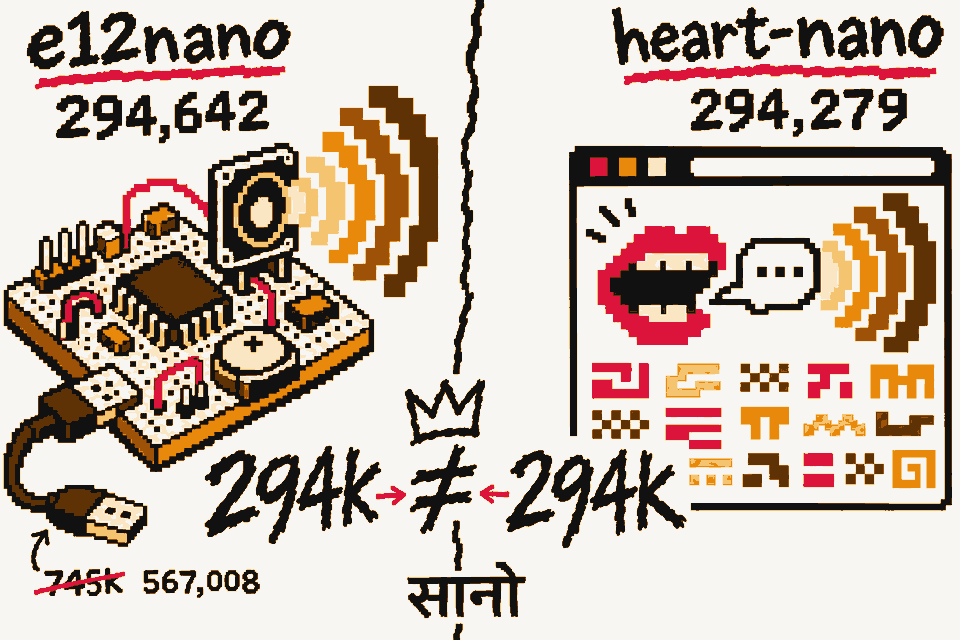
// the chip · e12nano
The chip result belongs to a model called e12nano, 294,642 parameters, compiled only
into the Arduino library — it isn't in the browser demo's 30 voices or the pip package's 27.
It shares an architecture and the identical on-device int8 decoder code with the browser's voice; their
internal names, e12nano and e13b, are one experiment apart. "Same sequence,
one step apart" isn't "the same model." Nobody has put e12nano in a browser.
The number itself holds up well. On an ESP32-S3, the shipped SIMD build gets RTF 0.383 — 2.6 times faster than the audio it's producing — against a scalar build's 1.58, slower than real time. SIMD alone is a measured 4.13× speedup. All four build variants, SIMD or not, dual-core or not, produce bit-identical audio; only the speed changes.
The correctness gate requires both a correlation check and an output-scale check — they once saw a broken integer FFT pass the correlation test while playing audio ~500× too loud. A speed number without both gates "is not a result."
On the same board, same scalar kernel, model differing only: e12nano scores RTF 1.58 /
corr 0.9947 / 399 KB flash against the larger shipped robot/R7 voice's RTF 3.69 / corr
0.9890 / 731 KB. Only 3 boards have real Arduino-path measurements; everything else "builds, never
measured" or is untested.
// the browser · heart-nano
The browser demo is real too — 30 voices across 16 languages, nothing to install, text goes through an espeak-NG phonemizer compiled to WebAssembly and then that voice's own tiny network, nothing leaving your machine. But the ten languages added this September — German, Turkish, Russian, French, Spanish, Italian, Portuguese, Romanian, Czech, Arabic — are checked only against sixteen held-out sentences each. That tells you the words come out intelligible, not that anyone would want to listen to them.
Vietnamese and Indonesian score far worse on the no-reference quality metric than English does —
1.53 and 1.71, against English amy's 4.13 — even though the words mostly arrive
correctly. No non-English voice in the whole catalog has been through a human listening test.
Shrinking heart to heart-nano, 7.7× smaller, held word
accuracy almost exactly — 0.083 WER against 0.080 — but the no-reference quality score
dropped from 3.48 to 2.29. That tradeoff, not any single RTF number, is the real finding here.
Independent downstream work exists too — a Japanese clean-room reimplementation and M5Stack
ports, other authors' work, not Ampixa's. An independent AtomS3 report passed correctness but missed
real time on a different model, language and board entirely — not a failed replication of
e12nano.